Yesterday I sent through a proposal I have been jointly working on to the Dunedin City Council on behalf of Holmberg Technologies Inc.
RE: Submission – Proposal – Sustainable Management Option - Ocean Beach
Dear Mick
In response to the Dunedin City Council (DCC) public request for submissions on solutions for the sustainable management of Ocean Beach I hereby submit a Proposal and supporting information to DCC on behalf of, and in support of, Holmberg Technologies Inc.
Please find enclosed:
1. A proposal from Holmberg technologies Inc. for a Scoping, Option Design and Costing project.
2. Client testimony - John Ricciardi
3. Client testimony - Dr Thomas Straw
4. A DVD with
- Holmberg Video 'Saving Beaches' (7 minutes)
- Holmberg Technologies Inc. Scientific and Technical Reviews of Projects Study Booklet
- Article - 'alternatives to traditional ways of treating shoreline erosion'
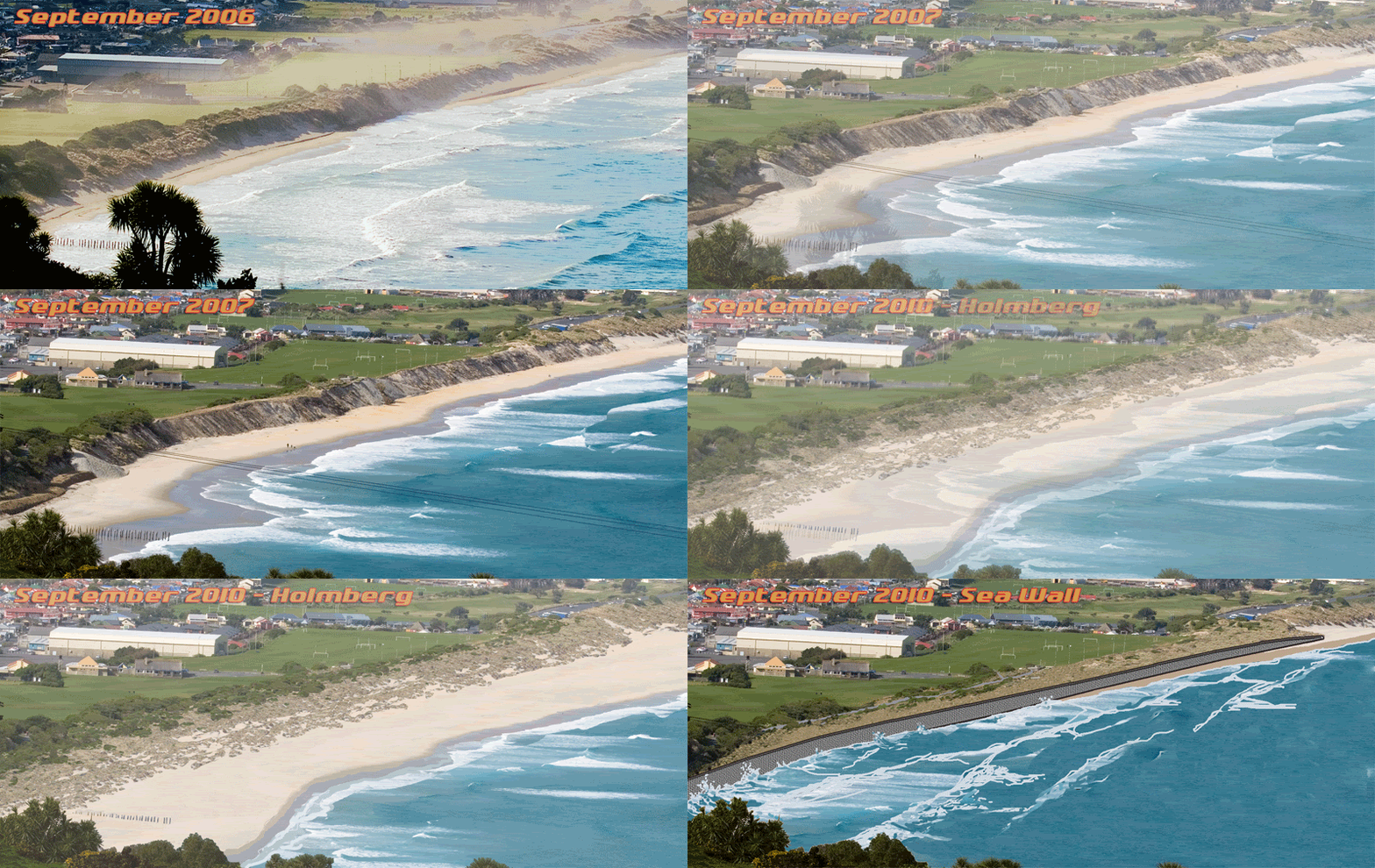
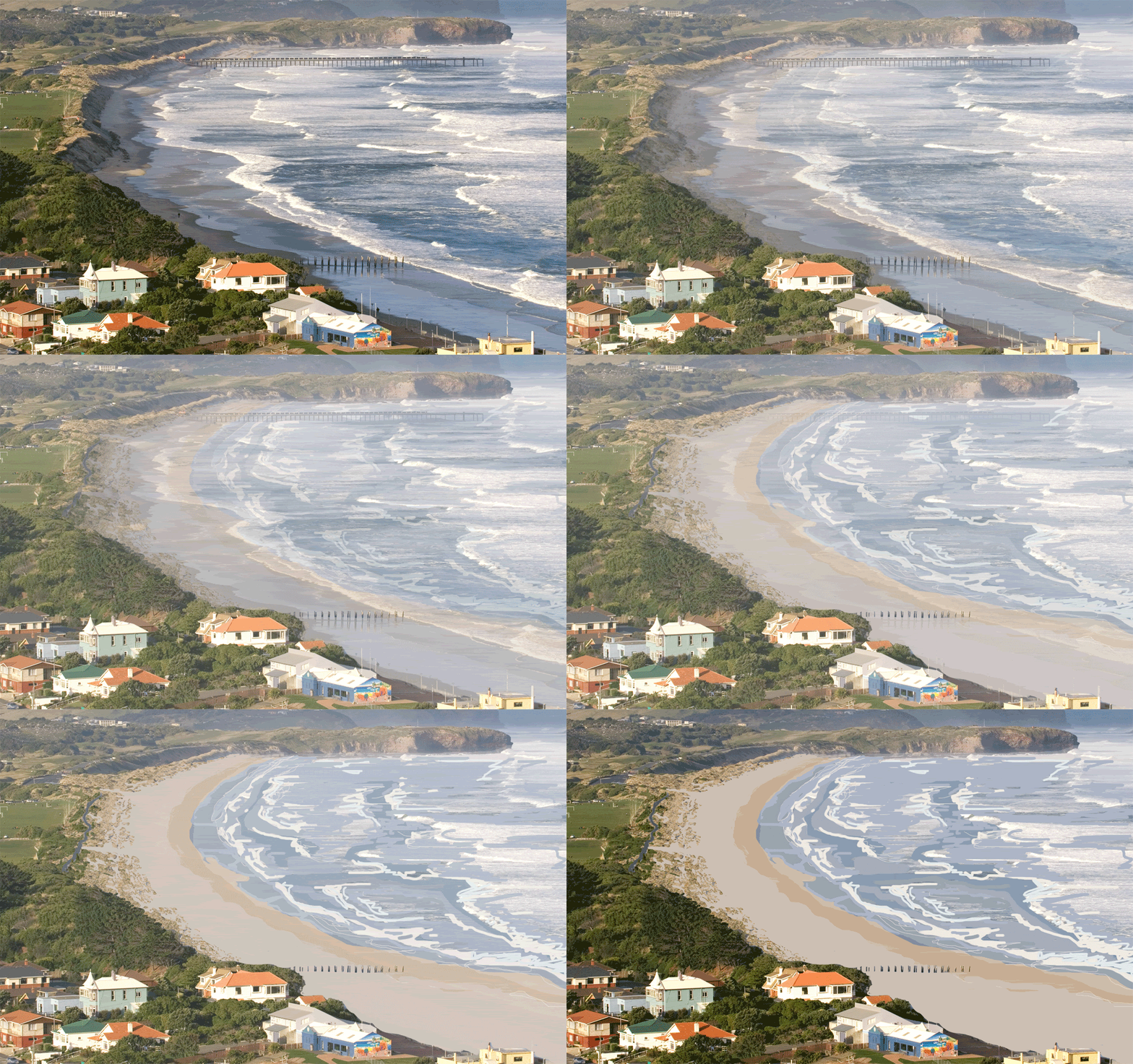
- File Folder - animated gifs of artist impressions of Ocean beach before and after appropriate intervention by Holmberg Technologies Inc.
(Please note post intervention results have been verified as practicable by Dick Holmberg of Holmberg Technologies Inc. – with provisos)
4. An artist impression of ‘Middle Beach Beach Profiles’ demonstrating the potential effects and benefits of the Holmberg technologies Undercurrent Stabilizers™
5. Two digital artist impressions of 'before and after' implementation of a “whole of beach” option intervention by Holmberg Technologies Inc. across Ocean Beach.
Following are the contact details for the Cairns City Council Infrastructure
Engineer who requested a proposal from Holmberg Technologies Inc. and
indicated an interest in discussing a jointly funded AUS/NZ working visit
by Dick Holmberg late 2007 early 2008 with NZ Councils.
(contact details removed for blog)
I hereby make this submission in “good faith” and without any liability whatsoever as a concerned and responsible citizen in the interests of the community and the environment and declare that I have no commercial interest in Holmberg Technologies Inc.
I trust this submission assists Council manage the risks associated with this issue efficiently and effectively.
I advise that this submission will be posted on my internet Blog at www.phoam.blogspot.com
Should you have any questions and or require further information in relation to this submission, please do not hesitate to contact me.
I look forward to your response.
Nicola Reeves
_______________________________
SUBMISSION BELOW
_______________________________
Attention: Nicola Reeves
Dear Nicola,
I write on behalf of Holmberg Technologies Inc. to outline a Proposal for the development of sustainable, long-term, soft -shore protection options for Ocean / Middle Beach, Dunedin, for your consideration and pursuit with Dunedin City Council.
This Proposal follows confirmation from Dick Holmberg to you on 17 October 2007 that your artistic impression of Ocean and Middle beaches was practicably achievable through the appropriate intervention of Holmberg Technologies Inc.
This Proposal is also a response to the submission Tracey Crampton-Smith and yourself presented to the Dunedin City Council Community Development Committee on September 4th 2007 re coastal erosion management at Ocean / Middle Beach which for reference concluded:
"Coastal erosion methods such as 'soft shore protection' that have a proven track record of success in managing similar sites which can stand to open transparent assessment must be given urgent and appropriate consideration."
I confirm my previous information to you that I have recently responded to a Request For Proposal (RFP) from the Infrastructure Engineer of Cairns City Council, Queensland, Australia (AUS), for the intervention of Holmberg Technologies Inc. in that region, and, that this Engineer has indicated an interest in discussing with interested New Zealand (NZ) Councils, the sharing of costs for Dick Holmberg (and a contract Engineer where appropriate) to travel to NZ (as part of a joint AUS/NZ visit).
Our Proposal:
Soft-Shore Protection, Scoping, Option Design and Costing Project.
Outcome - The main outcome of this project would be coastal management design (and costed ) options for sustainable, long-term, soft-shore protection for Ocean / Middle Beach involving the intervention of Holmberg Technologies Inc.
Key Project Objectives - This project would have the following key objectives:
a/ Engage with Council and other key stakeholders to discuss and assess stakeholder needs, expectations and constraints etc.
b/ Conduct site assessments.
c/ Review and assess quantitative and qualitative, information (historical, anecdotal, technical and scientific) - (See Note 1 below)
d/ Develop soft-shore protection option performance criteria.
e/ Develop soft-shore protection design options including engineering concept designs. (See Notes 2, 3 and 4 below)
f/ Assess local construction logistics and constraints.
g/ Develop cost estimates for design options.
h/ Present options to Council. (See Notes 4 and 5 below).
Availability :
Holmberg Technologies Inc. would be available to commence this project as a NZ only or joint AUS / NZ project mid November to early December 2007 or mid January 2008.
Investment:
The estimated investment by Council for this project is (NZD): Consulting Fee: $100,000.00
Airfares (Return): US Consulting Team (Dick Holmberg + Engineer ) + NZ Consultant. = $32,000.00
+ Accommodation, Meals and local travel = 10 days = $8,000.00
Total estimated investment for Council = $140,000.00 + (excluding GST/tax).
Total estimated investment for Council with US Consulting Team travel cost shared with AUS Council = $126,000.00 (excluding GST/tax).
Notes:
1/ Council would need to provide all scientific, technical and historical information re the site (and immediate surrounding areas) and relevant erosion issues and organise other relevant matters (including meetings with people who may have historical information, Local and Regional Council Officers etc.) to facilitate this assessment.
2/ Engineering concept designs would be limited in detail by intellectual property constraints and will require further input (at additional costs) from Holmberg Technologies Inc. and their engineering advisors (without travel to NZ) at a later date for Resource Consent Application/Permit and construction purposes. Holmberg Technologies Inc. reserves the right to not include information the company considers is commercially sensitive and or secret.
3/ Holmberg Technologies Inc. reserves the right to limit the number of options
4/ The format of presentation would need to be discussed and agreed on with Council prior to commencement of the project.
I trust this Proposal assists in meeting the needs of stakeholders by providing a postive and pro-active way forward.
Please do not hesitate to contact me if you have any questions and or wish to discuss any aspect of this proposal.
I look forward to hearing from you.
Kind Regards,
Chris Johnson, BBS.
Australasian Representative
For Holmberg Technologies Inc.
+0064-9- 5358066



Today I attended the Public segment of the 6 weekly Community Development Committee's meeting, where today they were to present the "Coastal Emergency Works" Summary Report. Present were the current city councillors, mayor, other council employees & various members of the public.
I have been working this week with Tracey Crampton-Smith, [both a mayoral candidate, and candidate for a South Dunedin seat on the DCC]. The five minute presentation, which Tracey presented was intense but effective. I put together a very short video version of the erosion that has occured at Ocean Beach the last few months which was played in the first minute of the submission.
Video Below::
Below:: is the written summary page 'conclusions' that we presented based on the content of the verbal submission presented today.
CONCLUSIONS
Ocean Beach [St Clair, Middle & St Kilda] is an artificially positioned, highly exposed, high energy site at high risk of coastal erosion and therefore requires urgent and effective management.
1. Increased storm frequency, unpredictability and severity along with predicted sea level rise and global warming will increase enormously erosion risk at Ocean Beach in the future without practicable and effective long term management.
2. Erosion management methods based on “Hard engineering” methods such as sea walls, sand sausages and rock baskets have consistently proven to exacerbate erosion and require ongoing ratepayer funding and maintenance. Sand replenishment is both financially unsustainable and unproven as a long term solution, and therefore these methods are high risk.
3. The Dunedin City Council consultants, Dtec, have suggested it would be negligent to commit ratepayer funds to the previous design plans and that finding a new remedy should be addressed with some urgency. Council and consultants have agreed they do not have a long-term solution. In 2001 the UN Intergovernmental Panel on Climate Change, the IPCC, recommended the application of 'soft shore' protection schemes and advised avoiding the use of 'Hard' shore protection methods such as vertical concrete walls and rock piles.
4. Alternative “soft-shore” methods of coastal erosion management based on “Natural process” (such as Holmbergs' Undercurrent Stabilisation method), have been developed and proven to provide effective management of similar sites overseas.
5. Public consultation must be actioned expediently so that a sustainable long term plan can be implemented without being preempted by the currently proposed 'holding pattern' consisting of sand stockpiling and rock baskets. However, the public should be given the opportunity to be consulted and agree on solution performance criteria.
6. Since the coastal zones affected by a solution will be fall under the jurisdiction of the Otago Regional Council and the Dunedin City Council both Councils should work jointly on this issue throughout.
7. Coastal erosion methods such as 'soft shore protection' that have a proven track record of success in managing similar sites which can stand to open transparent assessment must be given urgent and appropriate consideration.
There have been many theories and talk about a suitable method of restoring our dunes to a safe and acceptable state without extensive costs and risks.
1/ More Sand Sausages.
2/ An artificial reef or bank.
3/ Continual re-supply of sand from the Otago Harbour/Tomahawk
4/ Sand trap fences, as Duke Gilles did in the old days
5/ Relocating Mitre10 Mega as an artificial reef
And all agreed the current action, although necessary is not a solution at all, just a bandaid.
I have had contact with an overseas company (Holmberg Technoligies) who have extensive experience and sucess in coastal dune restoration, and thought it offered an alternative to what is currently proposed, all it would need is the suppoort of the powers that be financially to empower the work.
Below is a copy of an email I received back from them:
Hello Nic,
Thank you for contacting Holmberg Technologies Inc.
Your contact details have been forwarded to me as the Rep.
"down under."
I've checked your Blog out and it is great! - you and fellow
Bloggers appear to share our concerns re conservation of the
coastline.
The situation on the coastline in Otago reminds me of the old
Chinese proverb which goes something like: -
"A crisis is merely an opportunity in disguise!"
The crisis on the Otago coastline is an opportunity for our
company to assist you through our knowledge and experience
and, (I suggest) an opportunity for stakeholders to learn
from the past, and open their minds to support a proven
alternative.
>From your perspective at least stakeholders should have
learnt some tough lessons about the limitations of concrete
walls and sand filled tubes and (soon to come!) sand
replensihment as a means to "defend" the land against the
open sea!!!
These methods simply dont work effectively (without adverse
effects on the environment) because the basic underlying
strategy of trying to defend against the sea is
fundamentally flawed.
Holmberg Technologies Inc's strategy is to facilitate
reconstruction of a beach profile to create a natural self
sustaining beach and dune system - i.e. Holmberg's strategy
works with nature rather than the "traditional" engineering
approach of working against nature - like most brilliant
ideas quite simple really!
To do this we use geotextile tubes filled with concrete to
initially (and after storms) trap sand suspended in the
system to rebuild the beach profile.
We use concrete because experience has shown that sand
filled tubes dont stay intact for long, replenished sand
washes away (and eventually money runs out for its
replacement etc.) and the new beach needs the solid
underpinning of concrete to cope with storm conditions.
The tubes we use become buried out of sight very quickly in
open coastal environments and have not been shown to
interfere with the surf zone.
As you will have probably seen from the examples on the our
website Holmberg Technologies Inc has the experience and
technology to manage the type and magnitude of situation
which you are facing in Otago.
What we will need eventually however is the united support
of stakeholders.
If you have questions please do not hesitate to contact me.
I have attached some introductory information which you may
want to post on your Blogg.
Kind regards,
Chris Johnson,
Australasian Representative
For Holmberg Technologies Inc.
_____________________________________
Some more information about Holmberg Technologies
_____________________________________
Holmberg Technologies Inc.
Undercurrent Stabilizer™ System
A Proven Alternative Coastal Erosion Management Solution
Globally, the issue of how to effectively manage coastal erosion is of increasing concern to those who have an interest in the conservation of our precious coastal environment.
Over thirty years ago, Dick Holmberg, a visionary environmentalist, with a unique understanding of the oceans’ behavior gained from his experience as a deep-sea diver, became concerned about coastal erosion and the shortcomings of the methods that were being used to manage the problem. He responded by pioneering the development of an alternative coastal erosion management solution – the Undercurrent Stabilizer™ system.
To-date, Dick Holmberg’s company - Holmberg Technologies, Inc.- has applied Undercurrent Stabilizer™ systems to successfully manage coastal erosion in over 100 projects, responding to a wide range of site characteristics and objectives for clients that have included government, community and private interests.
In contrast to traditional approaches to erosion management, such as rock walls, groynes, artificial reefs and sand replenishment, Holmberg Technologies’ Undercurrent Stabilizer™ systems derive their success from working with nature, rather than against nature, to facilitate the reconstruction of a permanently self-sustaining shoreline environment.
A significant benefit of the Undercurrent Stabilizer™ system is that because it is a permanent self-sustaining solution, installations typically involve a once-only cost for assessment, design and construction. In most cases ongoing maintenance costs normally associated with traditional solutions are eliminated. At around US$2 million per mile Undercurrent Stabilizer™ systems are significantly cost-effective when compared to traditional solutions.
Often described as seabed speed bumps, Undercurrent Stabilizer™ systems are designed to slow sediment (e.g. sand or gravel) laden currents, to halt erosion and induce accretion.
Undercurrent Stabilizer™ systems successfully reduce wave energy and current velocities forcing the precipitation of indigenous sediment onto the shore. This reduction in velocity and hydraulic energy also reduces transport of sediment from the shore. The technology restores and protects the near-shore as well as facilitating the restoration and conservation of dunes and bluffs without interfering with the outer surf zone. The technology remains in place providing solid underpinning which facilitates storm protection.
Provided an initial feasibility study proves to be positive, an Undercurrent Stabilizer™ system is custom designed to address site-specific conditions, characteristics and performance objectives.
The system typically includes a geo-mass template designed to re-contour a deficit near-shore profile (one that loses sand) into a shallow, gently sloping accretion profile (one that gains sand). Each system is an interlocked network of concrete filled geo-textile tubes that extend like long “fingers” perpendicular to the coastline and sometimes incorporates a shore parallel component (especially where bluff or dune undercutting by wave action is possible).
Once installed, the technology follows the slope of the beach and near-shore and disappears completely out of sight, as the beach-face and near-shore accretes.
The effectiveness of Holmberg Technologies’ approach to coastal erosion management has been verified by independent scientific and technical studies and supported by international university research, as well as by thirty years of empirical evidence.
For more information visit: www.erosion.com and www.blufferosion.com
In Australia or New Zealand contact:
Chris Johnson, BBS. Australasian Representative, T/F 00-64(9)-5358066 – Email: andresim@ihug.co.nz
"The use of patented "Undercurrent Stabilizer" systems is being employed to work with nature by utilizing her wave, current and tidal energy carrying sand to the beach area from offshore deposits. This natural process actually accomplished the same result as artificial beach nourishment but without disturbing the natural ecology of the ocean bottom. An additional benefit is that it does not require continual replenishment, cause an increase in the erosion rate or the harmful effects that offshore dredging and strip mining does to maintain the beach (U.S. Corps of Engineers, 1989)"