Showing posts with label Sand Level Changes. Show all posts
Showing posts with label Sand Level Changes. Show all posts

Pic at Bottom: Harbour dredging's have been deposited on the wharf the last few weeks and trucked to Moana Rua Rd where massive amounts have been dumped off the end to build up the toe of the dunes. This spoil has then immediately been washed into St Clair with the east swells. You can see the scarp at the base of fill.


Time heals all wounds, nature is taking its' course in replenishing the sand at ocean beach.

Sand returning to St Clair beach..
Finally a notice is erected in an appropriate place to warn people of the danger of playing on the dunes. Action by the DCC has been called for since early August from members of the public both via email and the ODT letters to the editor.. my blog post.


Above two and below, recent East Swells have naturally replenished the beaches along the coast, especially noticable along the front of the sea wall at St Clair.
Below: a wider beach profile along from St Kilda to Middles can be seen.

the recent North East swells have pushed some elevating sand in at the base of the end of the sea wall.
some more shots of the constantly moving sandcastles below.

super low tide with new moon.. back to the rock bottom for St Clair (excuse the pun).

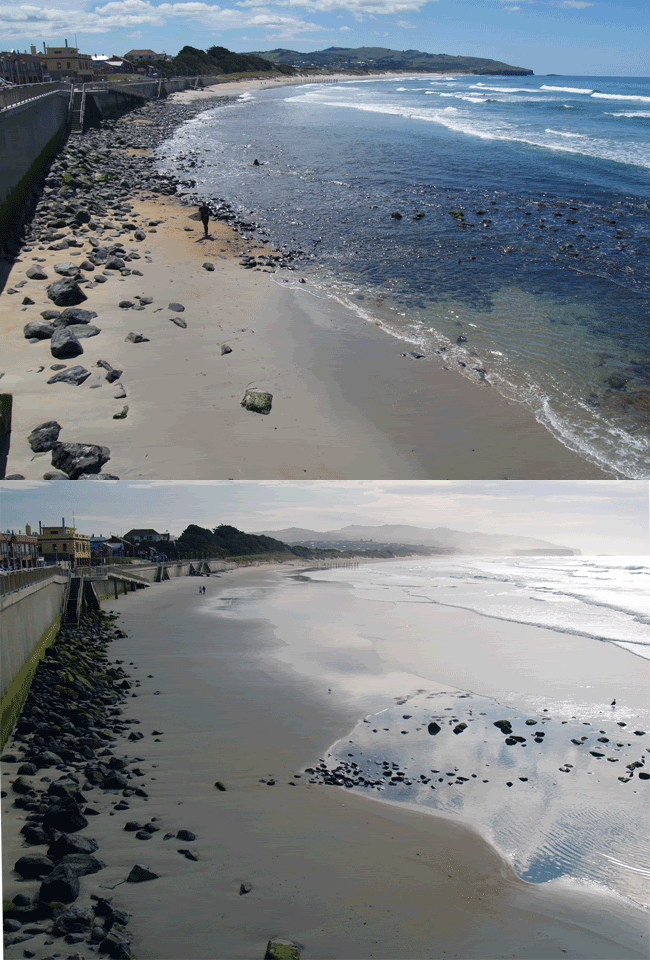
So this is what happens with a north east swell over a period of weeks.. the sand is coming back.. here are two photos taken approx 6 weeks apart.
the rocky one on the 6th of December, and one just yesterday on the 18th of january.
Both at the absolute lowest tide of the day.
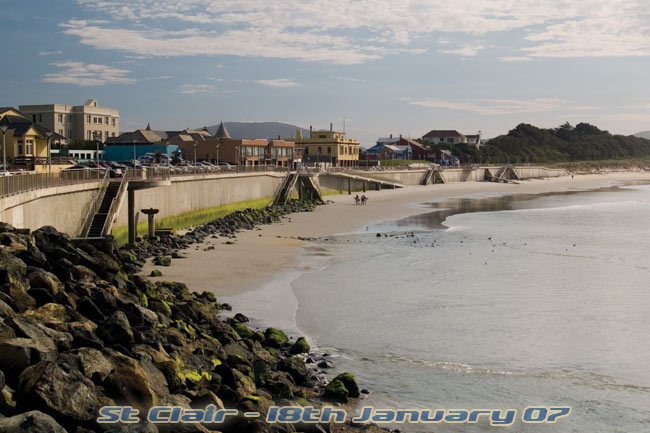
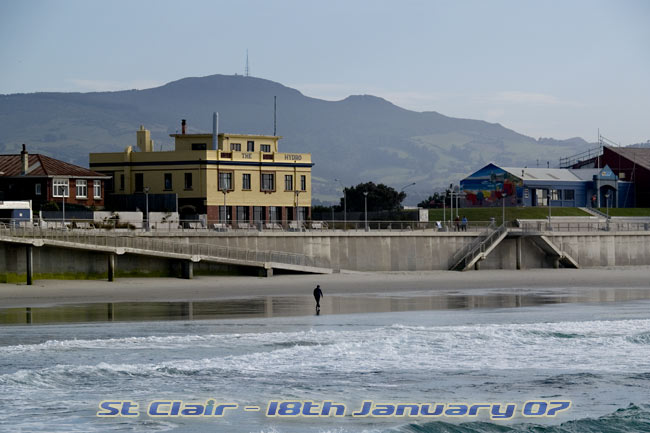
Top pic is St Clair at 8 am ish this morning.
The great thing happening is the build up of sand again !!
the ramp is repaired and can now function normally, as there is flat rockless sand at its base.
I have been working towards a bit of an article about the loss of sand at St Clair since the construction of the new sea wall.. and the pending resource consent to alter further the sand dunes and what remains of the natural coastline of Dunedin.
.. but the content of each of my days lately has made it difficult to focus on getting this issue out.
I need to at least say the scenario briefly now, or it may become too late.
It involves recontouring of the sand dunes at Middles, and Tomahawk beaches .. including the storage of thousands of tonnes of sand at Tommahawk Beach for 'replenishment sand stocks' for other Dunedin sites. It is presented as a conservation project.
The actual application on the DCC website - click here
More information with detailed applications - click here
Front page ODT a few weeks back...


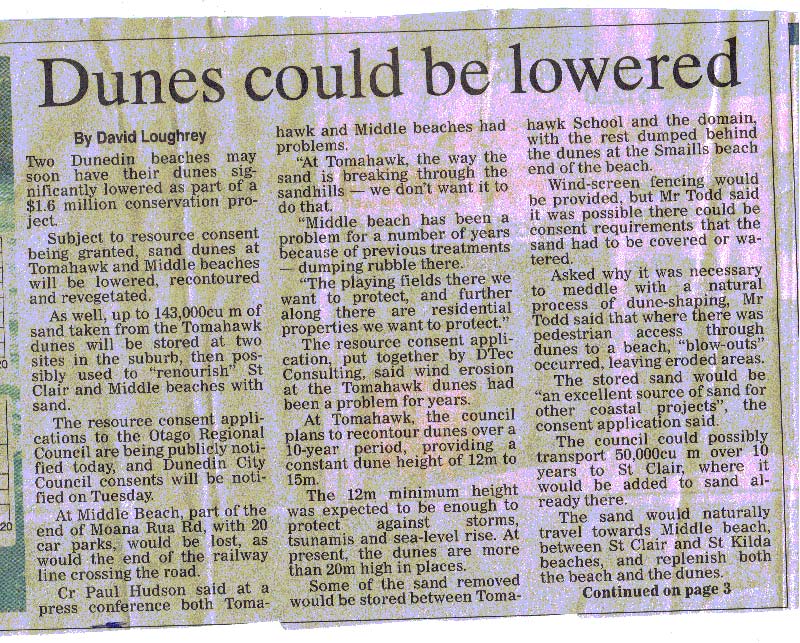
Submissions for and opposing close on the 29th of January 2007, having been extended from the original date of December 8th 2006.
MORE TO COME

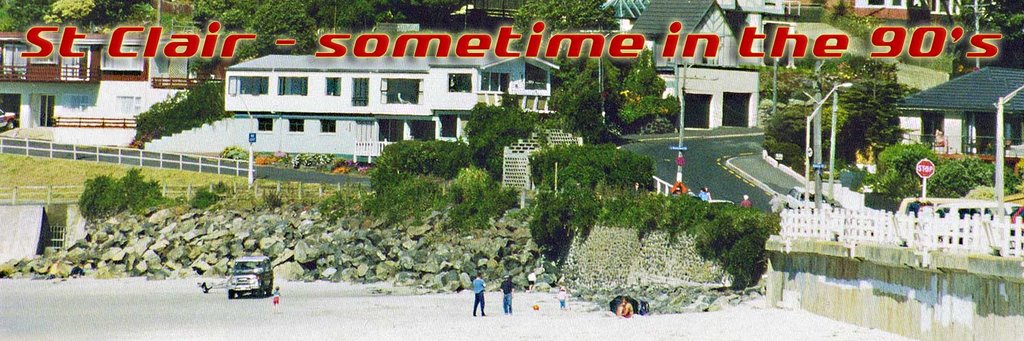
found and old pic in the album I just scanned, (now I've worked out how to scan straight into photoshop).. of the height of the pier piles november 1996 compared to august 2006. Since then even more sand has gone. Anyone keen to guess how much sand has gone? . hint the guy is 6ft 1 .
and ha ha, thats me on the left in matching stonewash denim jacket and jeans
and the white arrow points to the same pole in each picture
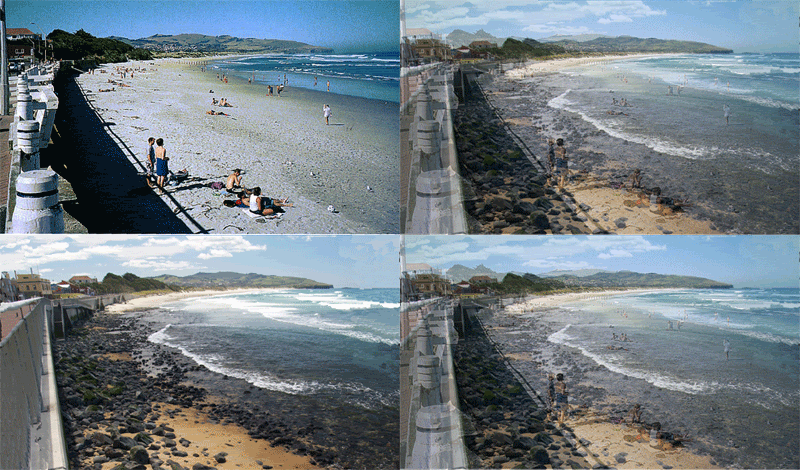
it happens on and off, the sand gets stripped away and then washed back in, but it's just fascinating all the same. Here are two shots taken 11 days apart.... looking towards the same set of steps.
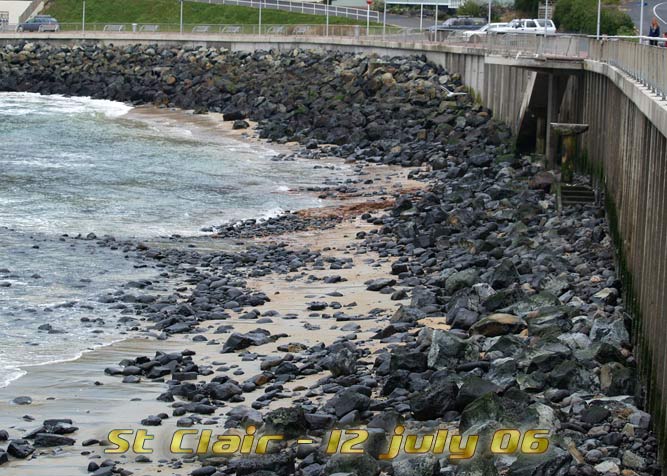
Erosion and accretion is a natural process, the Otago coastline has been in constant fluctuation for millions of years. Merely 7 thousand years ago the sea level was much higher than now and the peninsular arm was an offshore island. Even back in the 1800's the peninsular arm was only joined to South Dunedin by a sandy isthmus.

What we are faced with now is the issue of maintaining some kind of equilibrium to protect the man made assets that were placed along and inshore of our coastline in the last 160 years from this natural process.
Where did it all go wrong?
I am no expert at all, but following my natural curiosity I have my theories based upon stacks of research.
1/ Before the white man came to Dunedin, the now almost straight stretch of beach from the salt water pool to lawyers head (Ocean Beach) was an indented sandy bay which reached about 800metres further inland, this was created by the natural offshore morphology in conjunction with the landforms at shore along the coast.

2/ .. white man settles in Dunedin.. and after a few decades decides that he needs more land for settlement and begins the process of land reclamation through the draining of the swamps from South Dunedin to St Kilda, the sand mining of the dunes for harbour land reclamation and subsequent development over the previously sandy bay. This occured over 90 years from 1860 to 1950 when most of the 'reclamation' was completed.
3/ During this time, ongoing and prior, a cyclic natural weather phenomena occurs in 7 to 13 year cycles where natural storm events cause heightened erosion along Ocean Beach. Some storm surge events thrust seawater inland as far as Hillside Road (2ks inland) inundating homes and businesses. Two prior hard rock sea walls were destroyed and the esplanade was washed away completely during one storm event. So began mans battle with the ongoing issue/need for coastal protection, and the implementation of various engineering solutions.
4/ The extensive land reclamation within the previous sandy bay area caused a complete destruction of the natural dune system, which had previously found equilibrium as a self healing system over thousands of years. (actually when Dunedin was first settled, there was only a sandy isthmus joining the peninsula to the mainland, and the flat area of south Dunedin and St Kilda and parts of St Clair was swampy uninhabitable land which was laboriously drained by the market gardening Chinese immigrants).
4a/ After the 1950's periods of effective 'soft engineering' sand stabilisation methods such as sand trap fences gave a reprieve from erosion issues for many decades. After the Ocean Beach Management was handed over to the Dunedin City Council in the late 1980's these methods were disbanded and the erosion issues resurged.
5/ Bring on in 2002 the redesign of the new sea wall at the St Clair end of Ocean Beach. Due to adjustments in its positioning the solid structure created seemingly subtle but critically ongoing changes in currents causing deep erosion of the sandy beach along its base and drastically lowering the beach profile. This placed stress through exposure of the toe of the reconstructed dunes at the end of the sea wall [with whats called an 'end wall effect'] stripping sand and exposing the sand sausages from beneath the dunes.. these sausages (placed as a means to protect the dunes from erosion) then became hard/end wall themselves. and forced the erosion further up the beach as an end wall effect into middles beach to soft dune.
5a/ there is also the possibility that the construction of the bridge/pipe for the sewer outfall placement has been causing disturbances on the nearshore currents which have amplified the erosion.
6/ Then bring on another natural cycle of a series of strong south east swells/storms during June and July this year which caused the lowering of the beach level/profile even more allowing the storm surges to attack the toe of the soft dunes.. causing 8-10 metres of dune depth to be washed away over this 6 week period.
The beach is now in a 'self heal mode', where banks have been naturally created offshore which act as a buffer to incoming swells so the wave energy is dissipated and does not effect too much the eroded dunes. In the past this process allows the beach profile to slowly raise allowing recovery of the dunes by creating a higher dry sand beach again, this dry sand blows onshore to reform fore-dunes, the eroded dunes naturally re-profile and re-grassing occurs, the dunes and beach heal.. Unfortunately it is not at all possible for a self heal to occur here as would have been the case pre-settlement, as the natural profile and function of the dunes has been destroyed.
So its up the the city council to research the best possible way to allow the beach to recover and the dunes to heal ( with help from hundreds of hours of digger work to remove hard fill used in the 50's for reclamation).
I just cross my fingers that they do their homework and take a look at the more natural processes that they have been alerted to [such as Holmberg] that will allow a process to be installed where nature is worked with in conjunction with human intervention.. it is very possible, and is proven overseas.
the dunes must also be allowed to encroach back landward into the reclaimed parks areas so at least some degree of self healing is possible.
we face the truth that the problem is 'man made, aided by nature', so the solution should be 'natural, aided by man'.