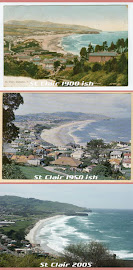
Weather patterns have been favourable recently with no low pressure events occurring during high tides. The minor depletion of sand previously noted at the beach end of the St Clair seawall has recovered completely. The regular beach access points are structurally sound. However, warning signs relating to the contamination of the dune area around the old landfill site at Kettle Park remain in place and with the area fenced off. Further testing is being carried out to determine the extent of contamination. The Project Team has been working with specialist risk advisors to complete a risk assessment of Ocean Beach, and will continue to work with them to develop and evaluate options to mitigate the risks identified. Once this evaluation is completed, a report will be prepared by the Project Team outlining recommended future treatment options for Ocean Beach for the Council's consideration.
Update: January 2011
Mixed weather over the summer has led to the occasional 'step' in the sand on Ocean Beach, but in general sand levels remain high overall. Late last year the Ocean Beach Project Team commissioned studies to determine the boundaries and types of material in the old Landfill site at Kettle Park. These studies found that there were some contaminants exposed on the seaward dune face at Kettle Park, and that might be a health risk to the public if there is prolonged exposure to the dunes in that area. Further studies to determine the extent and scope of the contamination are continuing. In the interim, warning signs and fencing has been erected to ensure the public are informed and guided away from the area in question.
The information gathering exercise will be drawing to an end shortly, and after the Project Team has completed a risk analysis process it will prepare its recommendations for future treatment of the Ocean Beach and report to Council.

The DCC was advised by engineering consultants, Tonkin & Taylor, that industrial material buried under the Kettle Park playing fields may have been exposed on the seaward dune at Kettle Park.
Indications are that there is a possibility of a health risk to the public with any prolonged or on-going exposure to these dunes.
The Project Team has been gathering information on the extent of the old landfill site at Kettle Park. Recently, it commissioned studies by Tonkin & Taylor to determine the boundaries and types of material in the old landfill site. This involved boreholes and samples being taken below the playing fields and the surrounding area, including the adjacent dune face.
The studies indicate that there is construction material and industrial waste under the clay cap which covers the playing fields. This was suspected, and the studies confirm that the waste is safely covered and there are no health issues whatsoever with the playing fields.
The investigations have, however, identified that these buried materials have been exposed on the seaward dune, probably as a consequence of compression over time.
These are preliminary findings and further studies will be commissioned immediately.
However, indications are that there may be a possibility of health risk to the public with any prolonged exposure to the dunes adjacent to the playing fields at Kettle Park.
Any risk relates only to prolonged and on-going exposure, but there is nonetheless a need for caution. It should be emphasised that there is no risk to the users of the adjacent sports grounds at Kettle Park.
The engineers who carried out the investigations have recommended that the DCC:
"carry out further investigations immediately to confirm whether the samples taken are representative and that any significant human health risk exists. A statistically based investigation will provide a robust basis for decision making about the management of the landfill and the coastal dunes."
The evaluation made by Tonkin & Taylor has been on the basis of a limited sample data and therefore must be regarded as preliminary only. However, it indicates that:
- long term exposure on sections of the dunes at Kettle Park may present a human health risk; and that
- it appears unlikely that the exposed materials present an immediate risk.
Signage is being prepared and will be installed at the Kettle Park beach access points and at all other access points along Ocean Beach as a matter of urgency. It is anticipated the signage will include the information below:
Sign Number One (at the Kettle Park area)
Caution
Members of the public are urged to stay clear of this area of dunes.
Preliminary studies into the old landfill site in this area show some industrial contaminants on the seaward side of these dunes. Until further studies have been completed, the Dunedin City Council advises that there may be a health risk to members of the public from prolonged and on-going exposure to the dunes in this area.
Further information is available by phoning 477 4000.
Sign Number Two (at other beach access points)
Caution
You are advised to stay clear of and avoid all contact with the dunes adjacent to Moana Rua Road.
Preliminary studies into the old landfill site in that area show some industrial contaminants on the seaward side of those dunes. Until further studies have been completed, the Dunedin City Council advises that there may be a health risk to members of the public from prolonged and on-going exposure to the dunes in that area.
Further information is available by phoning 477 4000.
Update: February 2010
Assisted by excellent weather over most of February, sand levels over the Ocean Beach continue to be very high, with all access ways open. Work continues on the background research that is needed, and the keen observer may have noticed a series of red and yellow buoys near the surf zone. These are helping to identify the direction and speed of in shore currents, and are part of the wide ranging studies on Ocean Beach. Those studies should all be completed by mid-year, and the Council will be considering the information received and future options a little later in the year.
Update: November 2010
Continuing benign weather conditions have ensured that beach profile (sand levels) on the Ocean Beach continues to be high.
The major event during the month was, however, identification of contaminants in the dunes immediately adjacent to Kettle Park. Specifically, industrial material buried under the Kettle Park playing fields, from an old landfill site, had been exposed on the seaward dune These findings were identified by studies into the dunes that had been commissioned by the Council.
Surf clubs and relevant authorities have been advised, and warning signs have been placed at all beach access points.
A more detailed investigation of the contamination at Kettle Park is planned, with results from new tests expected before Christmas. It should also be noted that the studies showed that the clay cap and sand covering the construction material and industrial waste under the playing fields is effective and there are no health issues with the fields themselves. Further information will be placed on this site when the results of the tests become available.
Esplanade options evaluated
ODT Wed, 22 Sep 2010
Click photo to enlarge

Government instructor Simms demonstrates fruit spraying at Clyde. - Otago Witness, 28.9.1910.
The matter has for some time engaged the attention of the Dunedin and Suburban Reserves Conservation and the St Clair Improvement Societies, and a large and influential deputation from these bodies waited on the City Council last night.
This was not a small local matter. An esplanade was required for St Clair, and anything that tended to be betterment of the Ocean Beach meant the benefit of Dunedin as a whole.
The deputation would ask the council to bear in mind that it did not in any way wish to reflect on either the Ocean Beach Domain Board or the St Kilda Council, for it fully recognised the valuable work which both these bodies had done; but both had been hampered by lack of funds.
What esplanade existed was being gradually washed away, and surely the council must see that it was an urgent matter. He might mention also that the movement had the sympathy of the Ocean Beach Domain Board. The idea was to extend the esplanade to Forbury Road, as originally built.
Dr Roberts pointed out that to have an esplanade extending from St Clair to Forbury Road would be a very great boon to the community, and would be used by thousands of people, not only from Dunedin, but visitors from elsewhere.
Nothing had been done to enhance the natural beauties of this part of the coast. There was not even a seat provided.
Mr J. A. Park pointed out that in the Ocean Beach the city possessed an important asset which had been much neglected This beach proved a constant attraction to a very large number of respectable people, and it was for these that this deputation, with the held of this council, proposed to cater.
The Mayor assured the deputation of his sympathy, and assured them that he would do all in his power to further its wishes. He could see nothing in the way of allocating something and he would do his best to have something put on the list. In the meantime the council would refer this matter to a committee. The cost of the esplanade will probably be about 3000.
• Considerable activity prevails at present in horse-dealing between Australia and New Zealand. The steamer Victoria, which left Auckland for Sydney on Monday night, took away 30 draught and 47 light horses, and the Wairuna, which left for Newcastle yesterday, shipped a further consignment of 140 draught horses.
A New Zealand dealer who has just returned from Melbourne states that there is still a big demand in the Australian markets for New Zealand horses, and that good quality animals could be easily disposed off. West Australia, he said, was particularly eager to buy.
- ODT, 22.9.1910.

Update: October 2010
The strong south westerlies that marked September carried on into October, although in the latter half of the month the wind direction reversed, with strong north easterlies prevailing. Despite the strong winds the beach is well stocked with sand, with all access ways available.. It is hoped that the high beach profile (sand levels) will be maintained over the summer months, with more settled nor' easterly weather expected over the summer.
The investigation process into the old landfill site at Kettle Park continues and it is hoped that these studies will be largely completed before Christmas. It is likely that the thrust of the Team's report to Council and any consequential recommendations for action will be largely determined by the results of these landfill studies.
Update: September 2010
There were some large 'swings' in September's weather, with rain, a few fine days, big waves, very high tides and lots of wind. So it is pleasing to record that despite some fluctuations in sand levels, with small 'steps' created by wave action from time to time, that the beach is in a well replenished state. The regular access routes to the beach are all accessible at the present time, and with the more settled nor' easterly weather expected over the summer months, it is likely that sand will continue to build up.
The process of investigations into the old landfill site continues, and the Project Team is hoping that this investigation and other studies will be largely completed before Christmas.

Dunes commended as coastal buffers
Article taken from the Otago Daily Times website - By Rebecca Fox on Mon, 13 Sep 2010
People have to change the way they live with their coasts and understand them a lot better, applied coastal scientist Jim Dahm says.
About 55 people attended the "Empowering coastal communities to adapt to climate change" workshop, organised by the Dunedin City Council and Dune Restoration Trust, at Long Beach Hall on Saturday.
Mr Dahm, who was one of the speakers at the workshop, said people needed to adjust their behaviour and live more in harmony with the coast. "We can't win the fight with our beaches."
It had been shown in other seaside communities that alternatives to expensive engineering works like sea walls were effective and also restored and enhanced the amenity and recreational values of coasts.
The idea that "dumping" a seawall along a coast would fix the problem was a "nonsense", he said.
These changes would not happen overnight, but if people better understood their coasts and changed their behaviour, it could be done, he said.
"Making use of natural protection is often the best protection. You create the space and have a natural buffer like a dune and appropriate natural vegetation."
Dunedin City Council coastal parks officer Renee Gordon said once people understood the dune process, talks could begin about what could be achieved along Dunedin's coast.
She hoped people at the workshop would take the information back to their groups and communities and raise awareness of the value of dune system.
read the entire article here

Update: June/July/August 2010
While there have been changes in sand levels in recent months, the 'benign' winter weather has meant there has only been fluctuations rather than any significant reduction in the beach profile (sand levels) on the Ocean Beach.?? The high beach profiles on Ocean Beach for the first part of the year have?? provided a good buffer recently. Areas of rubble have been exposed then recovered from time to time, and there has been no need to 'top up' sand levels so far this winter. All access points remain open. Having said that, care needs to be taken when accessing the beach, as a 'step' is present along much of the beach.
On 31 August 2010, the Ocean Beach Project Team (which was established in 2009) submitted a report to the Community Development Committee on progress to date with all studies. The Project Team advised the committee that further information is still coming to hand, and that a further report will be made to Community Development Committee when studies into an old landfill site have been completed.
Dunedin's Ocean Beach Domain is the frontline in an ongoing battle between sea and land that has serious implications for the low-lying suburbs behind the dunes. The forces at work, not least the hand of man, have shaped a significantly modified environment.
Change has been brought about by the pressure for raw resources in a developing city, the introduction of marram grass and ultimately the need to tame the coast for the physical protection of the city.
There are lessons here for those who are prepared to look at the mistakes of the past, say Paul Pope, of the Dunedin Amenities Society, and the late John Perry.
• Kaituna
Ocean Beach is a highly modified environment. The normal activity and movement of sand has been altered in favour of a more stable landscape. The former back-dune areas have been extensively mined and become recreation areas.
The coastline still stretches from the St Clair cliffs in the west to Lawyers Head in the east, but the sand dunes have become much thinner and steeper.
In 1848 in the west around St Clair, the sand hills were much smaller and lower, and the mouth of a lagoon ran through these dunes. They accumulated and grew as you moved east towards Lawyers Head.
High ground was in the west at the St Clair hills and in the east at the beginning of Otago Peninsula and beyond them, Otago Harbour and its extended tidal areas.
Between these features was a low-lying wetland named Kaituna. It was covered with silver tussock, rushes and flax and was an area of traditional food-gathering for Maori who sought tuna (eel), pukeko and weka.
There is also evidence that the Kaituna area was once thick with trees, probably kahikatea. They lay buried under the surface of the wetland and were often dug up and used as firewood by early settlers.
A significant feature was a track along the landward edge of the sand hills, which provided easy access to Kaituna.
By 1876 the urban growth of Dunedin had pushed housing to the edge of the sand hills at Ocean Beach. Sand was being removed constantly by householders to raise the level of their sections. Occasional floods are reported in the 1870s, but mostly from the harbour, into South Dunedin.
On one occasion a Mrs Rae and her two daughters were rescued by a gasworks boat crew from Rankeilor St. Their dog was reportedly left behind.
 Dunedin's battle of dunes
Otago Daily Times
Sat, 1 May 2010
Dunedin's Ocean Beach Domain is the frontline in an ongoing battle between sea and land that has serious implications for the low-lying suburbs behind the dunes. The forces at work, not least the hand of man, have shaped a significantly modified environment.
Change has been brought about by the pressure for raw resources in a developing city, the introduction of marram grass and ultimately the need to tame the coast for the physical protection of the city.
There are lessons here for those who are prepared to look at the mistakes of the past, say Paul Pope, of the Dunedin Amenities Society, and the late John Perry.
• Kaituna
Ocean Beach is a highly modified environment. The normal activity and movement of sand has been altered in favour of a more stable landscape. The former back-dune areas have been extensively mined and become recreation areas.
The coastline still stretches from the St Clair cliffs in the west to Lawyers Head in the east, but the sand dunes have become much thinner and steeper.
In 1848 in the west around St Clair, the sand hills were much smaller and lower, and the mouth of a lagoon ran through these dunes. They accumulated and grew as you moved east towards Lawyers Head.
High ground was in the west at the St Clair hills and in the east at the beginning of Otago Peninsula and beyond them, Otago Harbour and its extended tidal areas.
Between these features was a low-lying wetland named Kaituna. It was covered with silver tussock, rushes and flax and was an area of traditional food-gathering for Maori who sought tuna (eel), pukeko and weka.
There is also evidence that the Kaituna area was once thick with trees, probably kahikatea. They lay buried under the surface of the wetland and were often dug up and used as firewood by early settlers.
A significant feature was a track along the landward edge of the sand hills, which provided easy access to Kaituna.
By 1876 the urban growth of Dunedin had pushed housing to the edge of the sand hills at Ocean Beach. Sand was being removed constantly by householders to raise the level of their sections. Occasional floods are reported in the 1870s, but mostly from the harbour, into South Dunedin.
On one occasion a Mrs Rae and her two daughters were rescued by a gasworks boat crew from Rankeilor St. Their dog was reportedly left behind.
Dunedin's Ocean Beach Domain is the frontline in an ongoing battle between sea and land that has serious implications for the low-lying suburbs behind the dunes. The forces at work, not least the hand of man, have shaped a significantly modified environment.
Change has been brought about by the pressure for raw resources in a developing city, the introduction of marram grass and ultimately the need to tame the coast for the physical protection of the city.
There are lessons here for those who are prepared to look at the mistakes of the past, say Paul Pope, of the Dunedin Amenities Society, and the late John Perry.
• Kaituna
Ocean Beach is a highly modified environment. The normal activity and movement of sand has been altered in favour of a more stable landscape. The former back-dune areas have been extensively mined and become recreation areas.
The coastline still stretches from the St Clair cliffs in the west to Lawyers Head in the east, but the sand dunes have become much thinner and steeper.
In 1848 in the west around St Clair, the sand hills were much smaller and lower, and the mouth of a lagoon ran through these dunes. They accumulated and grew as you moved east towards Lawyers Head.
High ground was in the west at the St Clair hills and in the east at the beginning of Otago Peninsula and beyond them, Otago Harbour and its extended tidal areas.
Between these features was a low-lying wetland named Kaituna. It was covered with silver tussock, rushes and flax and was an area of traditional food-gathering for Maori who sought tuna (eel), pukeko and weka.
There is also evidence that the Kaituna area was once thick with trees, probably kahikatea. They lay buried under the surface of the wetland and were often dug up and used as firewood by early settlers.
A significant feature was a track along the landward edge of the sand hills, which provided easy access to Kaituna.
By 1876 the urban growth of Dunedin had pushed housing to the edge of the sand hills at Ocean Beach. Sand was being removed constantly by householders to raise the level of their sections. Occasional floods are reported in the 1870s, but mostly from the harbour, into South Dunedin.
On one occasion a Mrs Rae and her two daughters were rescued by a gasworks boat crew from Rankeilor St. Their dog was reportedly left behind.
Update: April 2010
Data collection and information covering research into the different aspects of the Ocean Beach is continuing to come to hand, although completing some research is taking a little more time than the Council would ideally prefer. The Project Team's report to the Council on the best options for Ocean Beach can only follow the receipt of all relevant information, and that report will now almost certainly be in the second half of 2010.
On the beach itself, a combination of wind, rain, and very high tides have lowered sand levels significantly. As significant 'steps' have also formed in a number of areas, extreme care should be taken when accessing the beach at any time.

from the Otago Daily Times
By David Loughrey on Fri, 16 Apr 2010
The future management of Dunedin's "first line of defence" against the ocean, the city's coastal dune reserves, will soon be decided after hearings held this week.
The coastal dunes reserves management plan hearings attracted 52 submissions from groups including Save the Otago Peninsula and the Yellow-eyed Penguin Trust. Ten people attended Wednesday's hearings to speak.
Under the Reserves Act 1977, local authorities are required to develop reserve management plans.
Dunedin City Council staff identified 10 coastal reserves, including at Brighton, Karitane, Long Beach, Ocean View, Waikouaiti and Warrington, to be included.
The idea was to protect and preserve the natural processes of the dunes, and manage natural, biodiversity, scenic and cultural values, while providing for recreation that did not damage those values.
Hearings committee chairwoman Cr Fliss Butcher said a major issue that emerged at the hearing was horses and dogs on Warrington beach.
There was "definitely" a problem with uncontrolled dogs, and their effect on nesting birds.
The issue of horses may be dealt with in a separate process, but the reserve was a recreational area, and horse-riding was a recreational activity.
Other issues included concerns about erosion, something the committee would bear in mind, Cr Butcher said.
She hoped community groups similar to the Tomahawk/Smaills Beachcare Trust could be set up to look after the reserves, with help from the council.
"It's really important," she said of the plan.
"These dunes are our first line of defence."
The committee would deliberate next week, and the plan would go before the community development committee, before being signed by the council.

Differing views have emerged on the possibility of saving low-lying areas in southern Dunedin from sea-level rise.
Consulting engineer Dave Tucker yesterday said engineering solutions were available to deal with the issue, while Sustainable Dunedin co-chairman Phillip Cole, also an engineer, said a retreat from the area was inevitable.
A report released on Monday identified South Dunedin, St Kilda and St Clair as "hot spots" vulnerable to what could be a 1.6m rise in sea levels by 2090.
The report on the effects of climate change in Dunedin was commissioned by the Dunedin City Council, written by University of Otago Emeritus Professor of Geography Blair Fitzharris and released on Monday.
It said the city would eventually have to protect, retreat or evacuate areas including South Dunedin, St Kilda and St Clair.
Other problem areas were the harbourside, the lower Taieri Plain, including the Dunedin airport, populated estuaries along the coast, and the ecosystems of upland conservation regions.
In his report, Prof Fitzharris said the city needed to focus on "adaptation" to deal with the problem, and that was not a one-off event but a process that involved awareness-raising, the development of knowledge and data, and risk assessment.
Some adaptation was occurring on a limited basis, he said.
"However, there remain significant challenges to achieving concrete actions that reduce risks."
Implementing measures such as planned retreat and dune management, building design, prohibition of new structures and siting requirements that accounted for sea-level rise was difficult.
Mr Tucker has previously told the council it needed to form long-term mitigation strategies to deal with the effects of climate change.
Yesterday, he said two areas of Dunedin were not protected by hills: the St Clair and St Kilda beaches area, and the lower harbour near Port Chalmers.
The areas of risk if the sea came through were not just South Dunedin, but all the reclaimed land in the city, including land up to the Dunedin railway station, and up to parts of the University of Otago.
He suggested a "barrage" across the harbour that would take advantage of a natural bottleneck between Port Chalmers and Portobello.
The barrage would link Goat and Quarantine Islands, trapping water in the upper harbour during high tide and releasing it at low tide. That would deal with sea-level rise at the harbour end of the city, and could include turbines to produce electricity.
The beach end of the city "could be saved in some engineering manner".
"You only need to go to Holland," he said, where technology had been developed to keep the North Sea out of the country.
"I'm quite sure if you got consultants from Holland they would come up with ideas to stop sea ingress."
Update: March 2010
There have been some fluctuations in sand levels at the western end of Ocean Beach, with a small 'step' created by wave action near the Salt water Pool.
The regular access routes to the beach are all accessible at the present time, with sand levels at the St Kilda end actually starting to form additional dunes. With the more settled nor' easterly weather we have been enjoying recently, it is likely that sand will continue to build up while the settled weather continues.